


HISTROY OF PENICILLINS
Sir Alexander Fleming, a
Scottish researcher, is credited with the discovery of penicillin in
1928. At the time, Fleming was experimenting with the influenza virus in the
Laboratory of the Inoculation Department at St. Mary's Hospital in London.
The history of penicillin follows
a number of observations and discoveries of apparent evidence of antibiotic
activity in moulds before the modern isolation of the
chemical penicillin in 1928. There are anecdotes about
ancient societies using moulds to treat infections, and in the following
centuries many people observed the inhibition of bacterial growth by various
molds. However, it is unknown if the species involved were Penicillium species or if the antimicrobial
substances produced were penicillin.
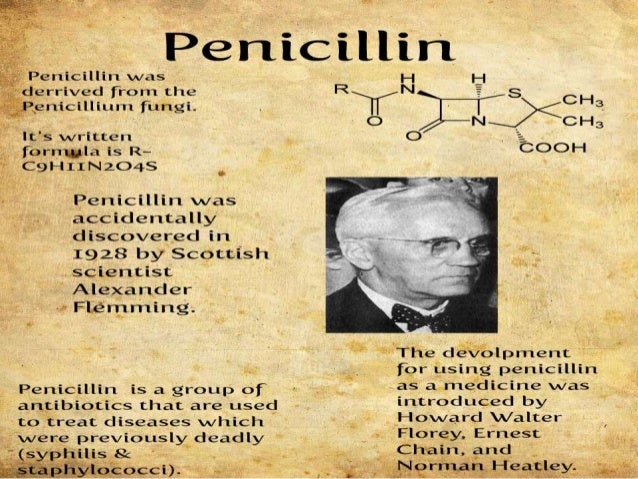
The
Scottish physician Alexander
Fleming was the first to suggest that a Penicillium mould
must secrete an antibacterial substance, and the first to concentrate the
active substance involved, which he named penicillin, the first modern antibiotic, in
1928. During the next twelve years Fleming grew, distributed and studied
the original mold, which was determined to be a rare variant of Penicillium notatum (now Penicillium rubens).
Many
later scientists were involved in the stabilization and mass production of
penicillin and in the search for more productive strains of Penicillium. Important
contributors include Ernst
Chain, Howard
Florey, Norman
Heatley and Edward Abraham. Shortly after the
discovery of penicillin, scientists found that some disease-causing pathogens
display antibiotic resistance to penicillin. Research that aims to develop more
effective strains and to study the causes and mechanisms of antibiotic resistance continues today.
Many
ancient cultures, including those in Egypt, Greece and India,
independently discovered the useful properties of fungi and plants in
treating infection. These
treatments often worked because many organisms, including many species of mould,
naturally produce antibiotic substances.
However, ancient practitioners could not precisely identify or isolate the
active components in these organisms.
In
17th-century Poland, wet
bread was mixed with spider webs (which often contained fungal spores) to
treat wounds. The technique was mentioned by Henryk Sienkiewicz in his 1884 book With Fire and Sword. In England in
1640, the idea of using mold as a form of medical treatment was recorded by
apothecaries such as John Parkinson, King's Herbarian, who advocated the use of
mold in his book on pharmacology.


👌👌👌👌👍
ReplyDelete👌👌👌👌👍👍👍
ReplyDelete